
This fall, our team spent a lot of time at events that had very little in common. We talked with restaurant owners and contractors at local expos, IT leaders at a technology showcase, aerospace suppliers in Rockford, mayors at Starved Rock, and fiber investors in New York.
Each group had their own questions but all had the same general concern. With internet connectivity being intertwined in day-to-day operations, people wanted to talk about how their network shapes what they can do.
“Connectivity used to be a line item. Nearly every leader we sat down with this fall is treating it as a growth decision now, and that changes what they should expect from the company that provides it.”
Darren Feder, CEO, Stratus Networks
The connection is part of the business now
At the Greater Springfield Chamber of Commerce’s “Shoes, Brews & Biz” and the East Peoria Chamber’s OktoberFest Business Expo, business owners told us they rarely thought about their internet connection until something went wrong.
That used to be a reasonable way to run a small business, but it isn’t anymore. Many technologies that businesses rely on have moved to the cloud, which means they now depend on their network. When the connection slows or drops, the business stops.
Upload speed has quietly become part of the picture too. Businesses rely on everything from video calls with customers to posting product video to social media. This means sending data out of the building, which depends on upload speed as much as download.
“Business owners don’t want to think about their Internet connection, and they shouldn’t have to. But when that connection goes down, everything from phones and payments to daily operations comes to a halt. ”
Chris Wise, Senior Sales Executive, Stratus Networks
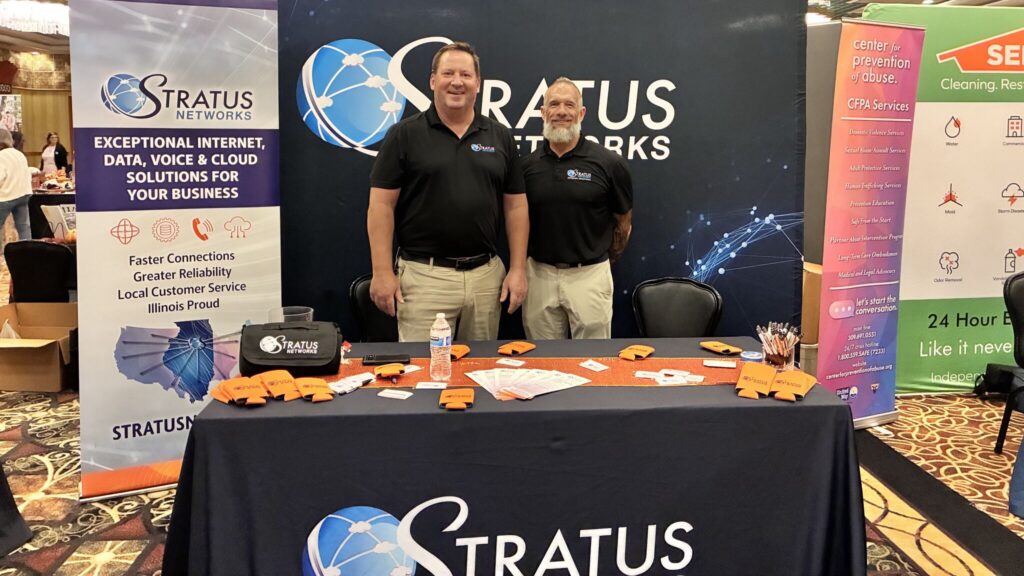
Pictured Above: Ron LaFond (left) and Chris Wise (right) at the East Peoria Chamber’s OktoberFest Business Expo.
IT leaders at Pearl Technology’s Central Illinois Technology Showcase described the same pressure at a larger scale. Every tool their clients add puts more demand on the network. What they want is connectivity that can grow with that demand instead of a network that needs to be rebuilt every few years.
For anyone weighing this decision, one exercise is worth ten minutes. List everything that stops working if your connection goes down for an hour on a Tuesday afternoon. For most businesses, that list is longer than they expect, and it’s the best measure of what the connection is worth.
Backup isn’t just for big companies anymore
Redundancy used to be an enterprise concern. This fall, some of the smallest businesses we met were asking about it. They have the least room for disruption, with no IT department on standby and no second office to fall back on. That’s why more of them are pairing fiber with a wireless backup connection, so a cut line or a construction crew down the street doesn’t mean a closed shop.
At the 2026 Midwest Aerospace Conference in Rockford, aerospace and defense suppliers had the same concern. They work under strict quality and compliance requirements, and their production floors are increasingly connected. Many need not only a second connection but a fully diverse fiber path (two physically separate routes into the facility), so a single fiber cut or equipment failure can’t stop the line.
In both cases, a connection with a single point of failure risks failing at some point. The difference between a small shop and a precision manufacturer is how much each hour offline costs.
“Manufacturers in Rockford build some of the most sophisticated products in the country. They expect their network to perform with the same precision, and they want a local team that understands what’s at stake when something goes wrong.”
Pat Shanahan, Sales Engineer, Stratus Networks
This is one area where Stratus does things differently from many providers. We can design diverse fiber paths, add wireless backup, and, through Stratus FLEX Cloud, host a company’s servers and protect its data with geo-diverse disaster recovery over private connections on our own network. The connection and the recovery plan come from the same team, which means one call when something breaks instead of a round of finger-pointing between vendors.
A five-person office and a multi-site enterprise want the same things
In Chicago, Todd Kiehn, our VP of Marketing & Product Solutions, spoke at Connectbase’s Connected World LIVE 2026 in a session called “Putting the ‘Total’ in Total Addressable Market.” The session looked at how providers design products and sales strategies to serve the full range of business customers.
It was a fitting topic since companies want a connection that works every day, performance they can predict, and ways to hold a provider to their service level agreement. They want room to grow without a rebuild, and a person they can reach when they need help.
That matters for anyone shopping for service. Smaller businesses often get sold consumer-grade plans with better customer support, as though reliability were reserved for bigger accounts. Larger organizations can run into the opposite problem, getting the capacity they need but losing the personal attention along the way. Neither trade-off should be part of the deal.
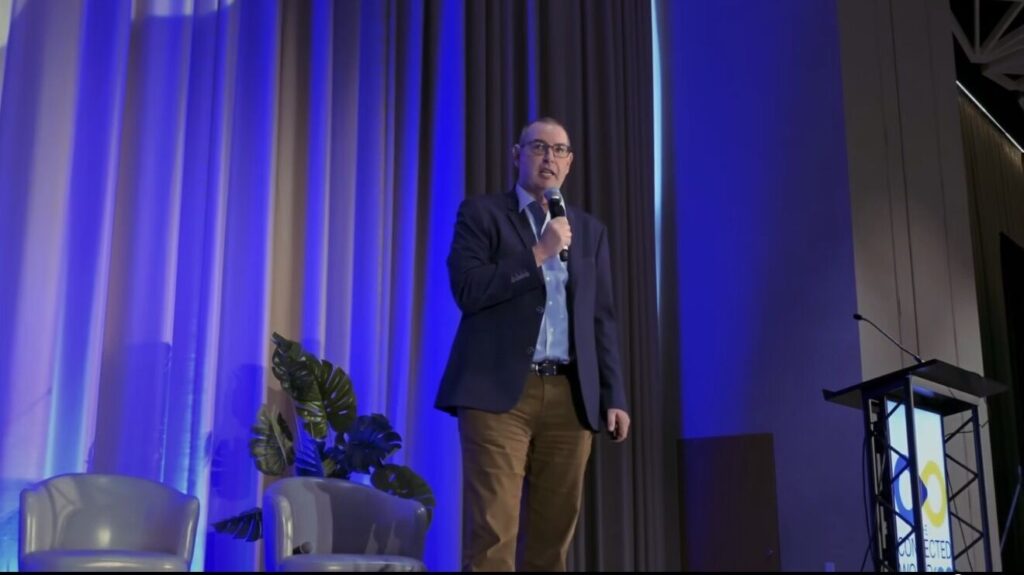
Pictured Above: Todd Kiehn speaking the Connectbase’s Connected World LIVE 2026.
“Small businesses and large enterprises need the same fundamentals, which are reliability, performance, and support they can count on. We’ve built our services so those fundamentals fit a small business as well as a multi-site enterprise, and neither one has to compromise.”
Todd Kiehn, VP of Marketing & Product Solutions, Stratus Networks
AI means the network matters again
At TMT Finance USA 2026 in New York, our CEO Darren Feder joined a panel on fiber investment in the AI era. Much of that conversation centered on the biggest drivers of the industry today, data centers, and long-haul routes that move enormous volumes of data between them. But AI is pushing demand at the other end of the network as well.
Most businesses in Illinois are using AI features built into the software they already use. Those tools run in the cloud and push substantial data in both directions. They work best over a connection with fast upload speeds and low latency, meaning a short delay between sending a request and getting a response.
Legacy internet technologies were designed with downloads in mind rather than upload speed, which often came in at a fraction of download speeds, and with traffic routing through centralized hubs far away from the user, which lowered costs but added latency. That arrangement held up fine when work meant email and web browsing. Cloud backups, video, large file transfers, and AI tools all need fast speeds for both uploading and downloading and low latency to maintain high performance. Fiber delivers symmetrical speeds, the same rate going up as coming down, and can keep traffic local to minimize latency. That’s a big part of why modern fiber networks are so essential for business growth today.
“AI is accelerating demand for fiber at every level of the network. The headlines focus on data centers and long-haul capacity, but on the ground it means the network matters again – local businesses need a fast, symmetrical, low-latency connection to the tools their teams use every day.”
Darren Feder, CEO, Stratus Networks
This means you should be asking your current provider a direct question about upload speeds and latency, and paying close attention to the answer.

Pictured Above: Stratus Networks CEO, Darren Feder, speaking on a panel at TMT Finance USA 2026.
Before your next renewal
Every room we sat in this fall pointed to these shifts. If your contract is coming up, or you’re planning a move or an expansion, a few questions are worth putting to any provider, including us. What happens to your business when the line goes down, and is there a second path or a backup connection behind it? What does the service agreement promise, and who picks up the phone when something breaks? How fast is your upload compared with the download number on the sales sheet?
The people choosing a network today are asking harder questions than they used to, and they should be. Fiber is no longer a premium upgrade. For a growing number of businesses, it’s what everything runs on.
Since 1998, Stratus Networks has been building connectivity for Illinois businesses, supported by a local team and award-winning customer service. To see whether Stratus fiber is available at your location, or to talk with our team about backup connectivity or FLEX Cloud, reach out to us.
—
This fall, the Stratus team attended “Shoes, Brews & Biz” with the Greater Springfield Chamber of Commerce, the East Peoria Chamber of Commerce’s Oktober Fest Business Expo, Pearl Technology’s 2026 Central Illinois Technology Showcase at the Peoria Riverfront Museum, and the 2026 Midwest Aerospace Conference, hosted by the Rockford Area Aerospace Network with the Greater Rockford Chamber of Commerce. At Starved Rock Lodge in Oglesby, Terry Huels and Tyler Evans delivered opening remarks at the Illinois River Cities and Towns Initiative Annual Meeting. Darren Feder joined a panel at TMT Finance USA 2026 in New York City, and Todd Kiehn spoke at Connectbase’s Connected World LIVE 2026 in Chicago.
Thank you to every host and partner who brought these groups together and made room for us in the conversation.